
Thinkinfast
RESULT
Secured letters of Intent from multiple
companies including
Adobe


TLDR;
I worked on thinkinfast as the founding designer, working directly with founders to create a decision board and assisted decision making tool from ground up.
Before Thinkinfast executives juggled multiple tools and spreadsheets, chased team leads for reports, causing high cognitive load and friction which leads to delayed and misaligned decisions.
I led 0 → 1 design to unify all the relevant data points into a singular platform, enabling executives to make faster and more informed decisions.
A human in loop concept designed to spot inefficiencies earlier and prevent mishaps while making data dependent decisions.
The MVP was successful in validating the product idea and we received multiple Letters of intent from companies like Adobe.
PROBLEM
There are different tools that optimize for individual functions like OKR’s, planning and Business Intelligence, leading to teams operating in silos. Executives dependent on teams struggle to get reports on time because of misalignment. This leads to delayed decisions.
Missed deadlines
Increased Risk
Slower decisions
Misalignment
Market research
I looked at the current products used to have a satellite view of companies metrics and make decisions.

Opportunities
We identified these gaps.

EARLY CONCEPT
We started with a basic prototype.

Initial product was just a KPI board.
CHALLENGE
The second challenge was control. Some users needed enough information to understand what was happening. But showing every detail would make it overwhelming. We focused on decision critical information and moved complexity behind an interaction.
The third challenge was reliability. We spent several weeks talking with users, ideating brainstorming. There were 5 versions of MVP prototype to understand where the product could break or become unclear.
defining main features And Final screens
A decision board that keeps every open call in one place - each card carrying the goals and KPIs it affects, its priority, and its owner, so nothing that needs a decision stays buried in a report.

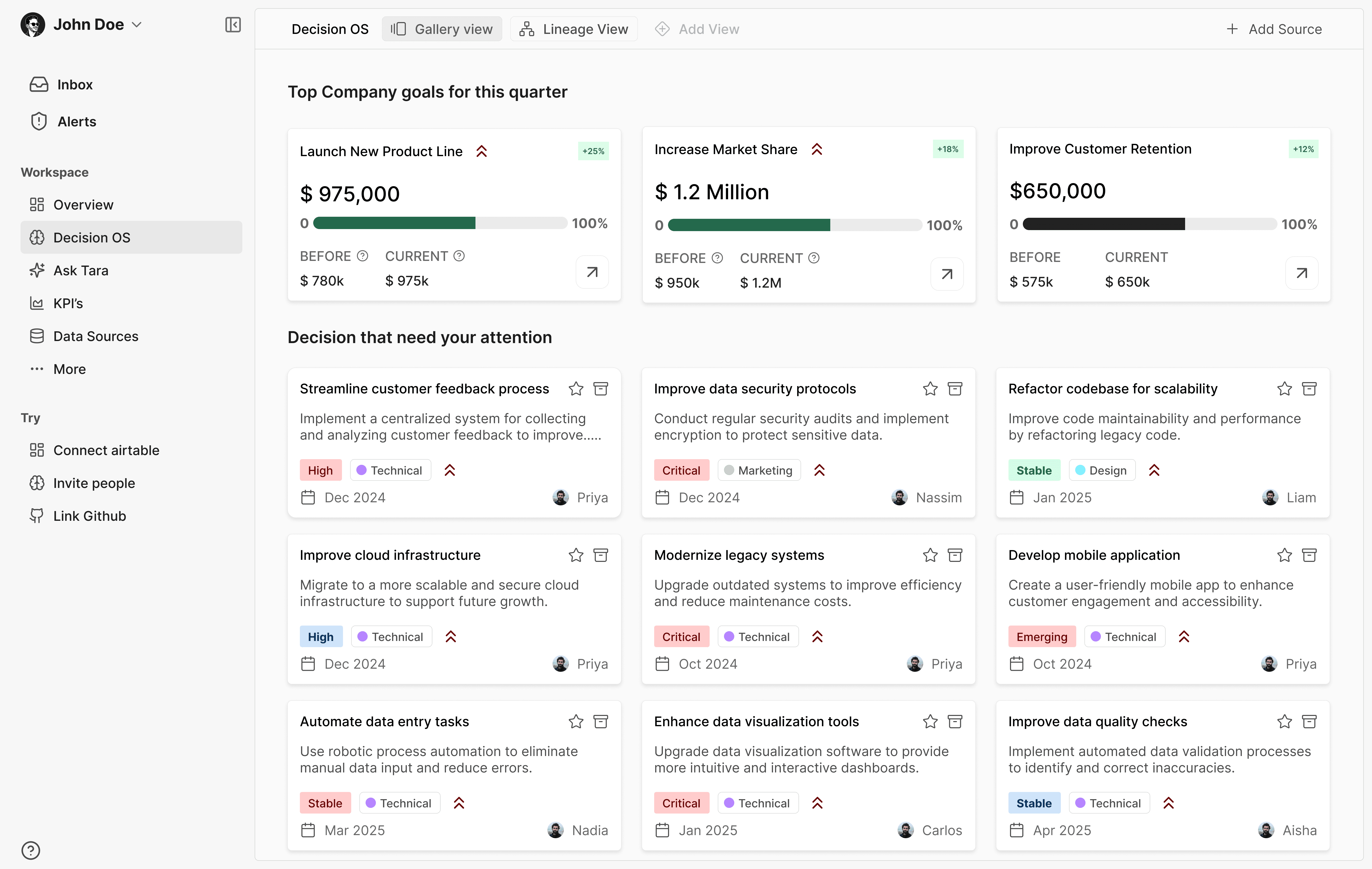


Decision card
Goal cards present business objectives with their current status, progress, and the KPIs driving them. Allowing executives to see where a goal stands without digging into reports.
KPI card
Decision cards frame open decisions with AI-assisted context, including the goals and KPIs affected. The final call stays with the executive, with the reasoning recorded for later.


Tags
The goal card
Goal cards present business objectives with their current status, progress, and the KPIs driving them. Allowing executives to see where a goal stands without digging into reports.

Launch New Product Line
+25%
Target : $2,000,000
$ 975,000
48.7%
BEFORE
$ 780k
Current
$ 975k
Infographics


This feature allows users to get a more detailed view of the KPI and other metrics. Here they can see the trends of the KPI’s and how they affected other metrics along with the timeline.

This feature allows users to quickly see which KPI’s are on the track and which are falling behind, making performance gap visible before they become bigger problems.

Outcome
GREAT SUCCESS!
retrospective
This experience sharpened my design and product thinking skills.
Domain knowledge as design material
Designing in this specialized environment meant learning the data, the methodology. This kind of understanding came through observing and speaking with users.
Embracing the loop
Each round of feedback was a chance to do something better, navigate the ambiguity, and ultimately get closer to the goal.
Constraints clarify
Designing With clear constraints forced me to get a clear on what the product actually needed and helped prioritize.
Read next
Life work

Sahaye

